Paper Published in Frontiers in Artificial Intelligence
2026.11.05
The AI So-Go-Chi Center is pleased to announce that the following paper, co-authored by Associate Professor Teeradaj Racharak and Assistant Professor Watanee Jearanaiwongkul, has been published in Frontiers in Artificial Intelligence (Impact Factor: 6.7; published on October 29, 2026). Frontiers in Artificial Intelligence is an open-access, peer-reviewed international journal that publishes research across the broad field of artificial intelligence.
Published Paper
Atitaya Yakaew, Teeradaj Racharak, Matthew N. Dailey, Watanee Jearanaiwongkul,
Lightweight audio-visual sentiment analysis with dynamic mouth-state modeling and multimodal LLM benchmarking
Frontiers in Artificial Intelligence, vol. 9, Article 1855069, 2026.
Paper: https://doi.org/10.3389/frai.2026.1855069
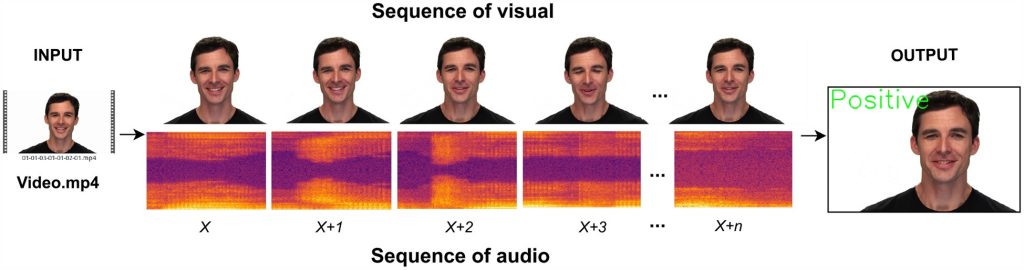
Sentiment analysis from video requires effective modeling of both temporal dynamics and multimodal cues. This paper presents a lightweight multimodal CNN-LSTM framework, designed for low-latency operation on live video streams, that classifies a person’s affective state as negative, neutral, or positive by jointly using audio and visual information. Dynamic mouth-state classification is also incorporated, helping the model capture subtle visual cues related to speech and sentiment.
Experiments on the RAVDESS dataset show that the proposed approach achieves a test accuracy of 84.89% on the three-class sentiment recognition task, competitive with substantially larger audio-visual architectures while using an order of magnitude fewer parameters. A comprehensive comparison with multiple multimodal large language models (LLMs) further offers practical insights into their strengths and limitations for audio-visual sentiment analysis, and highlights the continued effectiveness of compact, task-specific models for streaming audio-visual input.
Congratulations to the authors on this achievement!