
Development of Trustworthy and Human-Centered AI through Knowledge Representation, Machine Learning, and Evaluation
2026.06.02
Fiscal Year
FY 2025
April 2025 – March 2026
Principal Investigator
Teeradaj Racharak
Associate Professor, Advanced Institute of So-Go-Chi (Convergence Knowledge) Informatics, Tohoku University
Research Keywords
Trustworthy AI; Human-Centered AI; Knowledge Representation and Reasoning; Explainable AI; Large Language Models
1. Research Overview
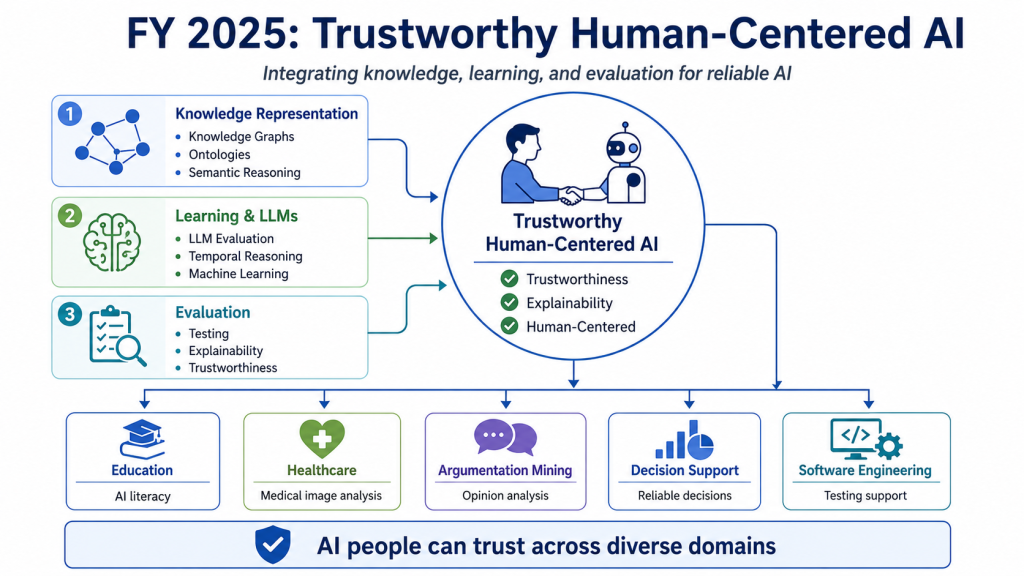
Artificial intelligence is now widely used in education, healthcare, software engineering, knowledge management, and decision support. However, as AI systems become more powerful, it is increasingly important to understand whether their outputs are reliable, explainable, and useful for human users. This research project addresses this challenge by developing trustworthy and human-centered AI methods that combine knowledge representation, machine learning, and systematic evaluation.
During the period from April 2025 to March 2026, the project produced achievements in several connected research areas. First, the project advanced research on trustworthy large language models by applying software testing concepts to evaluate in-context learning and by developing tools for testing the trustworthiness of LLM outputs. Related work also examined temporal reasoning in frontier LLMs, showing that current models still face difficulties when handling complex or mixed time expressions.
Second, the project contributed to knowledge representation and reasoning. Studies on knowledge graph embeddings, ontology completion, description logic, and semantic similarity supported the development of AI systems that can represent structured knowledge more accurately and explain their reasoning in a human-friendly way. These achievements are important for building AI systems that do not only produce answers, but can also clarify the knowledge behind those answers.
Third, the project extended trustworthy AI research to practical domains. In healthcare, research on lightweight medical image segmentation contributed to more efficient AI-assisted analysis. In education, work on AI literacy and the detection and explanation of ChatGPT-generated programs supported responsible use of generative AI in learning environments. In argumentation mining, the project explored how assumptions and contrary opinions can be identified in hotel reviews, contributing to better understanding of human reasoning in text.
Overall, the findings show that trustworthy AI requires more than model accuracy. It also requires structured knowledge, careful evaluation, explainability, and awareness of human needs. The project therefore contributes to a foundation for AI systems that are reliable, interpretable, and beneficial across multiple domains.
2. Impact and Future Outlook
The achievements of this project contribute to the development of AI systems that can be used more safely and responsibly in real-world settings. The project’s impact lies in connecting formal knowledge representation, machine learning, and practical evaluation. This combination is important because modern AI systems often generate fluent outputs without clearly showing whether the outputs are correct, consistent, or grounded in reliable knowledge.
The research outcomes have academic and practical significance. For academic research, the project provides methods and case studies for evaluating AI reliability, explaining semantic reasoning, analyzing temporal reasoning, and improving knowledge-based AI systems. For practical applications, the outcomes can support education, healthcare, software engineering, and decision support. For example, tools for identifying AI-generated programs can help educators discuss AI literacy and academic integrity, while research on medical image segmentation can support more efficient healthcare-related AI applications.
The project also strengthened interdisciplinary collaboration across areas such as natural language processing, software engineering, medical AI, ontology engineering, educational technology, and argumentation mining. This interdisciplinary direction is important for the So-Go-Chi vision, because trustworthy AI requires the integration of different forms of knowledge and expertise.
In the future, the study will continue in three main directions. The first direction is to develop stronger benchmarks and evaluation methods for LLM trustworthiness, temporal reasoning, and explainability. The second direction is to deepen the integration of symbolic knowledge, such as ontologies and knowledge graphs, with learning-based AI models. The third direction is to expand practical applications in education, healthcare, and decision support through collaboration with domain experts. These future developments will further support the creation of AI systems that are transparent, accountable, and human-centered.
3. Summary
This project advanced trustworthy and human-centered AI research from April 2025 to March 2026. The achievements covered large language model evaluation, knowledge graph reasoning, ontology completion, temporal reasoning, medical image analysis, educational AI, and argumentation mining. The project produced journal papers, international conference papers, workshop papers, book chapters, a book, and poster presentations. A central finding is that trustworthy AI requires not only high accuracy, but also explainability, structured knowledge, systematic testing, and attention to human needs. By connecting knowledge representation, machine learning, and evaluation, the project contributes to AI systems that are more reliable, interpretable, and useful in real-world domains such as education, healthcare, software engineering, and decision support.