
Neuroscientific Verification of the Educational Effects of English Conversation Training Using Generative Language AI
2026.07.06
Fiscal Year
FY 2025
April 2025 – March 2026
Principal Investigator
Chunlin Liu
Assistant Professor, Center for Applied Cognitive Neuroscience
Co-Investigators
Hyeonjeong Jeong
Professor, Graduate School of International Cultural Studies
Taira Nakajima
Associate Professor, Graduate School of Education
1. Research Overview
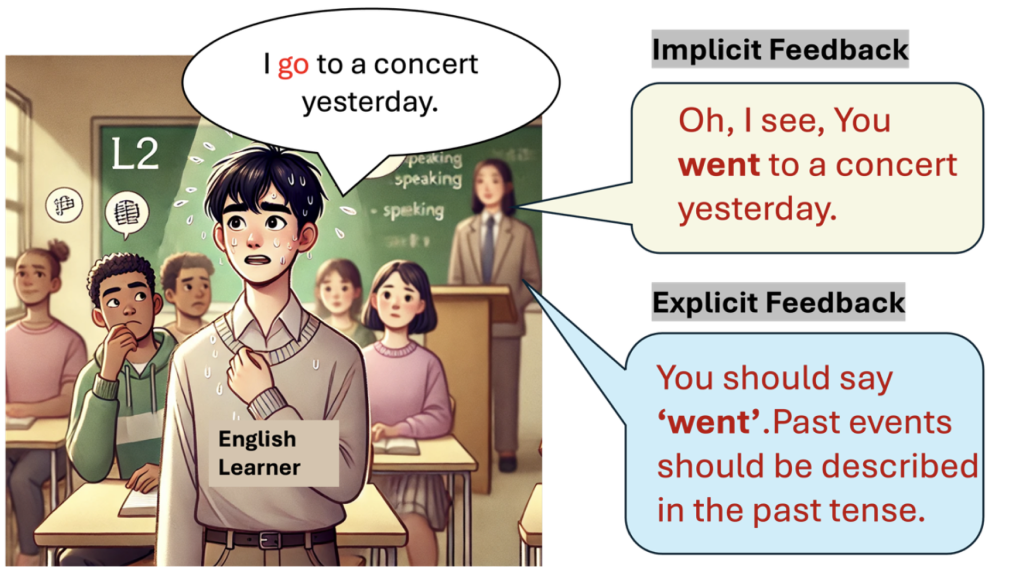
With the spread of generative AI such as ChatGPT, more people are using AI as a partner for English conversation practice. In language learning, correction, or feedback, is essential because it helps learners notice and correct their mistakes. However, the psychological impact differs depending on how the correction is delivered. Some corrections are direct, such as “You should say went, not goed,” while others are more indirect, such as subtly restating the correct expression. Traditionally, direct correction has been thought to cause tension, while indirect correction has been considered gentler. However, even if learners report that they do not feel nervous, it is difficult to determine from questionnaires alone whether the burden on the brain is truly small.
In this study, 33 Japanese learners of English freely conversed in English with an AI teacher on everyday topics while inside a functional magnetic resonance imaging scanner, a device that can observe brain activity in real time. During the conversations, they received three types of feedback: no correction, implicit correction, and explicit correction. The study successfully combined real-time free dialogue between humans and generative AI with brain imaging for the first time. It also measured each learner’s personality traits, particularly fear of being negatively evaluated by others and the level of anxiety they usually experience in communication.
The results showed almost no difference in self-reported anxiety across the three types of feedback. However, brain responses revealed a deeper picture that varied by individual. In learners with a strong fear of negative evaluation, explicit correction strongly activated brain regions related to social threat, such as the insular cortex and superior temporal gyrus, imposing an additional emotional burden. By contrast, in learners with strong communication anxiety, implicit correction, because of its ambiguity, pushed the brain into a state of heightened vigilance and effortful listening, creating an additional cognitive burden.
In other words, implicit correction, although it may appear gentle, does not always impose a smaller burden. It may simply replace an emotional cost with a cognitive cost. The research team calls this finding the “dual neural cost” of AI-based correction. This indicates that there is no single correction method that is optimal for all learners in AI-assisted language learning.
2. Impact and Future Outlook
As tools such as AI-based speaking practice systems and AI tutors rapidly spread into educational settings and everyday life, “how to correct” is no longer merely a question of teaching technique. It has become an issue directly related to learners’ emotional experiences and learning outcomes. This study is the first to provide neuroscientific evidence that the same correction method can create different types of burden depending on learners’ personality traits, and that there is no one-size-fits-all optimal solution.
These findings offer direct implications for the design of future AI educational tools. Ideally, AI tutors should not rely on a fixed correction strategy. Instead, they should be able to recognize learners’ emotional states and personality traits and dynamically adjust their feedback methods. For example, for learners who fear negative evaluation, the emotional pressure of explicit correction should be reduced, while for learners with strong communication anxiety, the cognitive burden caused by ambiguity should be avoided. This would make AI-assisted language learning both emotionally safe and cognitively clear.
Going forward, the research team will verify these findings with a larger sample and explore how to implement emotionally sensitive feedback design in actual AI educational systems.
3. Summary
More people are practicing English conversation using generative AI, but little attention has been paid to how AI’s way of giving corrections affects learners’ brains. In this study, 33 Japanese learners of English interacted in real time with an AI teacher in English while undergoing brain imaging, and their neural responses to explicit and implicit correction were compared. Although there was no clear difference in self-reported anxiety, brain responses differed across individuals: explicit correction caused an emotional burden in learners who feared negative evaluation, while implicit correction caused a cognitive burden in learners with strong communication anxiety. This “dual neural cost” shows that there is no single correction method that is best for all learners, and that AI tutors should adapt their feedback according to learners’ emotional characteristics.