
Elucidating the Value-processing and Information-integration Mechanisms of the Reward System in Interpersonal Emotion Regulation
2026.07.07
Fiscal Year
FY 2025
April 2025 – March 2026
Principal Investigator
Motoaki Sugiura
Professor, Department of Human Brain Science, Institute of Development, Aging and Cancer, Tohoku University
Co-Investigators
Shao Chong
2nd-year doctoral student, Graduate School of Medicine, Tohoku University
Role: experimental design, data collection, fMRI analysis (lead researcher)
Liu Chunlin
Assistant Professor, Center for Applied Cognitive Neuroscience, Tohoku University
Role: research guidance, experiment implementation, data collection, analysis support
Guan Lingfei
3rd-year doctoral student, Graduate School of Medicine, Tohoku University
Role: experiment implementation, data collection / analysis support
Chang Xiaoqian
2nd-year doctoral student, Graduate School of Medicine, Tohoku University
Role: experiment implementation, data collection / stimulus creation
Peng Xinyu
2nd-year master’s student, Graduate School of Medicine, Tohoku University
Role: experiment assistance, data collection
Yan Shuxuan
1st-year master’s student, Graduate School of Medicine, Tohoku University
Role: experiment assistance, data collection
Research Keywords
Interpersonal emotion regulation; Reward system; fMRI; Social motivation
1. Research Overview
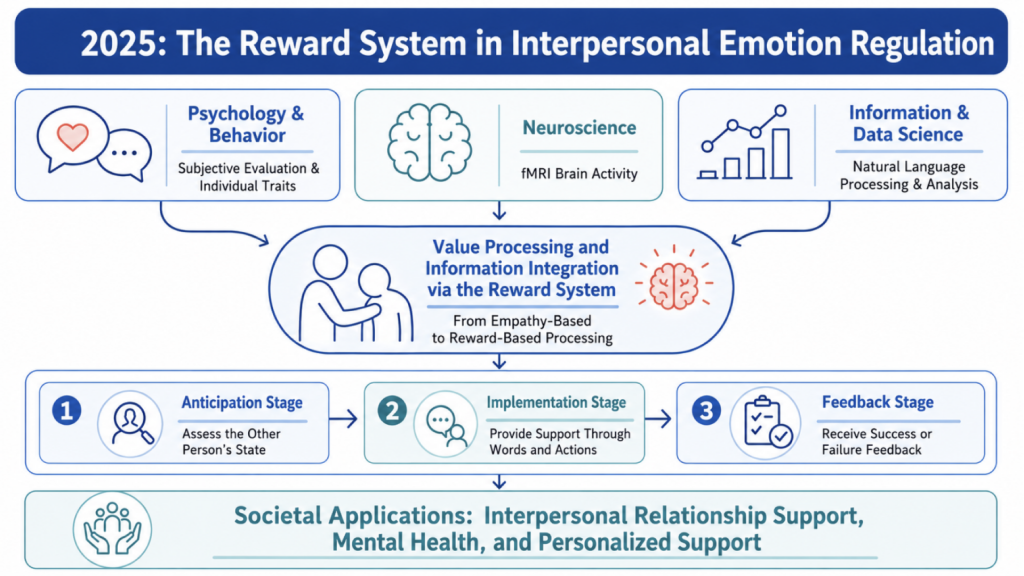
We routinely try to support other people’s feelings—encouraging a friend who feels down, or comforting someone who is anxious. This act of stepping in to ease another person’s emotions is called interpersonal emotion regulation (IER). Why do people try to support others’ emotions, even when there is no reward in return? This study focused on the workings of the brain’s “reward system”—the neural machinery underlying pleasure and satisfaction—that may lie behind this behavior.
Traditionally, the motivation to help others has been explained mainly in terms of empathy. More recently, however, it has been suggested that the act of supporting others itself brings a sense of satisfaction (reward) to the helper, and that this contributes to motivation and well-being. Yet it remained unclear how the reward system operates across the sequence of supporting someone—the anticipation phase (reading the other person’s state), the implementation phase (offering words of support), and the feedback phase (receiving the other person’s response)—and how brain responses differ when support “succeeds” versus when it “fails.”
In this study, healthy university students performed a task modeled on messaging-app exchanges inside a functional MRI (fMRI) scanner, while we measured brain activity across the three phases of emotion regulation. We also assessed personality traits, empathy, and reward sensitivity using questionnaires, and examined how these related to the brain responses.
Ongoing analyses suggest that, in the anticipation phase of reading the other person’s state, brain regions involved in inferring others’ minds (mentalizing) are engaged; and that in feedback situations where support did not go as expected (“failure”), activity increases in brain regions involved in reward prediction (the midbrain and striatum). Furthermore, the magnitude of these brain responses appears to vary with personality traits. Together, these findings offer clues for understanding the neural basis of the motivation to support others.
2. Impact and Future Outlook
The findings of this study may be applied to improving interpersonal relationships and supporting mental health. For example, understanding the brain responses that arise when support “does not go well,” together with the individual differences in motivation to support others, can capture the burden and the satisfaction that supporting others brings to the helper, and offer clues for designing emotional support tailored to each individual.
Academically, the view that the act of supporting others engages the helper’s own reward system opens a path to understanding compassion and helping behavior not only through “empathy” but also from the perspective of “reward and motivation.”
This study also spans psychology, neuroscience, and information science, and addresses how diverse linguistic information—situational descriptions presented as text, the helper’s own utterances, and feedback from the other person—is processed and integrated as “value” in the brain. In this respect it aligns with the cross-disciplinary integration of knowledge that So-Go-Chi aims for.
Going forward, we plan to complete the ongoing data collection, advance the analyses, and disseminate the findings through conference presentations and academic papers. We further aim to develop this work toward applications in interpersonal support, from the perspective of value processing of social linguistic information in the brain.
3. Summary
Encouraging someone who feels down—and other acts of supporting people’s emotions—are known as interpersonal emotion regulation. This study aimed to clarify why people try to support others’ emotions, focusing on the workings of the brain’s reward system. Participants performed a task modeled on messaging-app exchanges inside an fMRI scanner, while we measured brain activity across three phases: reading the other person’s state, offering support, and receiving their response. Ongoing analyses suggest that brain regions involved in reward prediction are engaged when support “does not go well,” and that brain responses vary with personality traits. These findings are expected to inform applications in improving interpersonal relationships and supporting mental health.