
Transformation of Thinking under AI Assistance and Clustering Analysis of Individual Differences
2026.09.25
Fiscal Year
FY 2025
April 2025 – March 2026
Principal Investigator
Taira Nakajima
Associate Professor, Graduate School of Education
Co-Investigators
Satsuki Torige
Second-year Doctoral Student, Department of Human Brain Science, Graduate School of Medicine
Research Keywords
AI-assisted decision-making ; Moral decision-making ; fMRI
1. Research Overview
Generative AI is rapidly spreading not only as a tool for writing and information retrieval but also as a means of supporting human judgment and decision-making. While receiving AI suggestions may reduce the burden of thinking, it may also weaken people’s sense of making their own judgments and their sense of responsibility. In particular, how AI support affects human thought processes in moral and social decision-making—where there is no single correct answer—remains insufficiently understood.
In this study, we used a decision-making task based on criminal sentencing and compared a condition in which AI suggestions were provided with a condition in which they were not. Participants performed the task inside an fMRI scanner, allowing us to examine how brain activity changes with and without AI support.
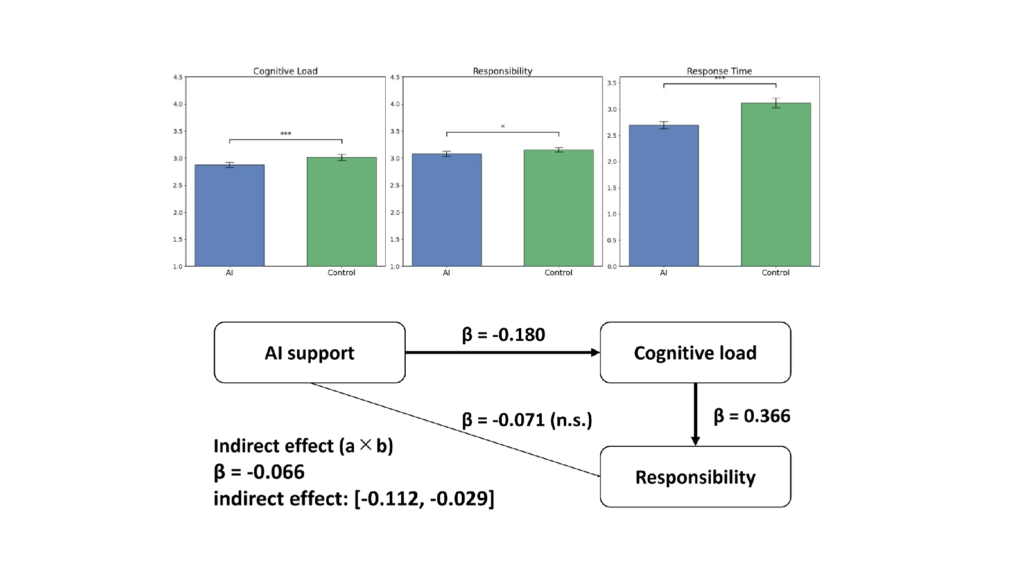
First, self-report measures showed that, in the AI-supported condition, cognitive load and response time decreased, while the subjective sense of responsibility also decreased. Mediation analysis further indicated that AI support reduced responsibility via reduced cognitive load.
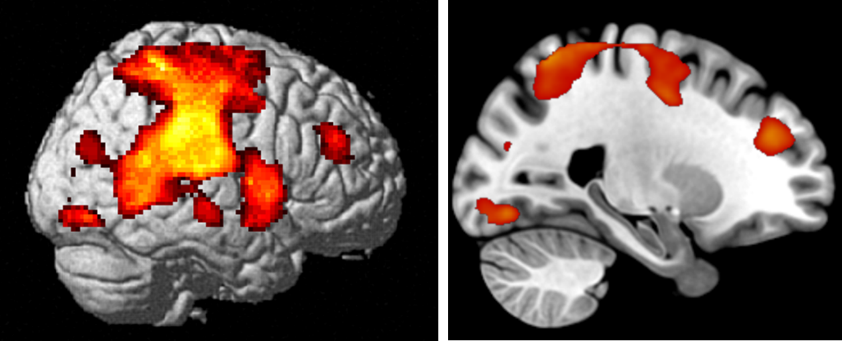
Regarding brain activity, we initially considered the possibility that AI support would reduce the brain activity associated with decision-making. However, the whole-brain analysis revealed no clear deactivation in the AI condition. On the contrary, in the condition with AI suggestions, increased brain activity was observed over a wide area centered on the supramarginal gyrus (SMG).
This result suggests that AI support may not simply bypass human thinking. Rather than accepting AI suggestions as they are, people who receive them may engage in processes of understanding the judgment presented by the AI, comparing it with their own, and incorporating it into their final decision. In other words, AI support does not mean “no longer needing to think”; instead, it appears to involve a new cognitive process of interpreting AI suggestions and integrating them as one’s own judgment.
This study provides foundational knowledge for understanding generative AI not as a technology that replaces human judgment, but as something that transforms the way humans think and make decisions.
2. Significance of the Research and Future Prospects
Generative AI is beginning to be used as a technology to support human judgment in many areas, including education, healthcare, the judiciary, public administration, and business. While AI suggestions may help organize complex information and reduce the burden of judgment, there are also concerns that they may affect people’s own thinking processes and their sense of responsibility for their decisions.
The significance of this study lies in showing that AI support does not simply reduce human brain activity, but may instead give rise to processing aimed at understanding AI suggestions and checking them against one’s own judgment. This suggests that AI does not simply replace human thinking, but becomes involved in the decision-making process in a new way.
Going forward, we will further examine individual differences in responses to AI support, including the cluster analysis that is the main objective of this study. This will help clarify who can use AI effectively and in what situations excessive reliance on AI is likely to occur, leading to the design of support that enables people to make use of AI while maintaining their own agency.
3. Conclusion
This study used a criminal sentencing task and fMRI to examine how suggestions from generative AI affect brain activity during human decision-making. Although AI support might have been expected to reduce brain activity during thinking and decision-making, the whole-brain analysis revealed no clear deactivation; instead, widespread increases in activity centered on the SMG were observed. This activity overlaps with regions involved in language comprehension, social cognition, and the integration of others’ perspectives, suggesting that people do not simply receive AI suggestions as information but engage in evaluating their validity and meaning. These results indicate that people may not accept AI suggestions as they are, but rather scrutinize and understand their content and integrate it into their own judgment.