
Exploring the Quantitative Gap toward Sustainable Food Choices Based on Consumer–Citizen Duality
2026.09.25
Fiscal Year
FY 2025
April 2025 – March 2026
Principal Investigator
Tomoko Imoto
Associate Professor, Graduate School of Agricultural Science
Research Keywords
Pro-environmental behavior ; Duality ; Consumer ; Citizen ; Organic produce
1. Research Overview
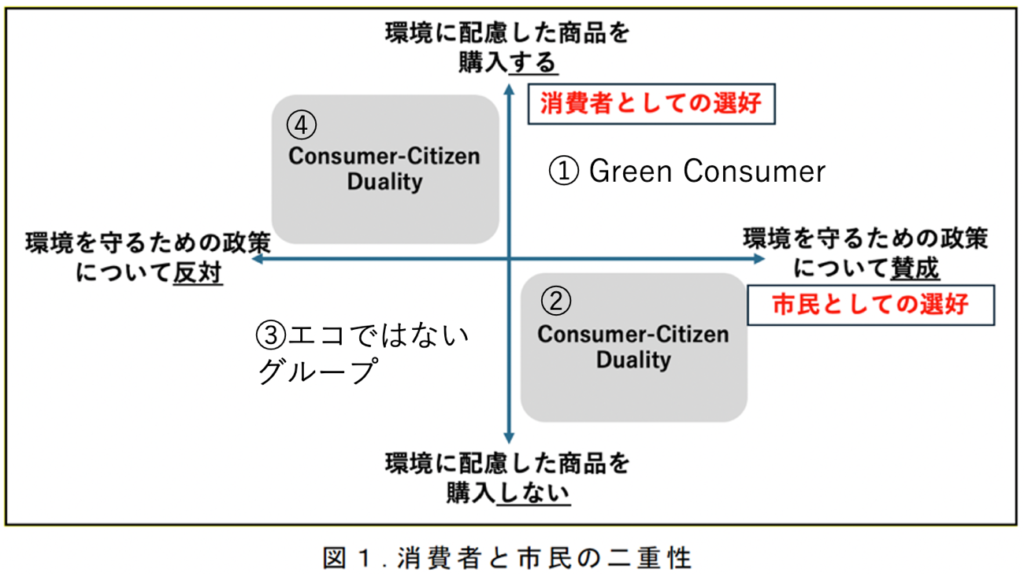
The aim of this study is captured by the question: “In favor of protecting the environment, yet not acting on it yourself?! Quantitatively unraveling the ‘duality’ within people.” In recent years, building an environmentally conscious society has been recognized as a fundamental challenge for humanity, and various policies and measures have been implemented to this end, with consumers also expected to change their attitudes. However, despite these measures, it is difficult to say that changes in consumer attitudes and behavior are progressing smoothly. This study regards this situation as a contradiction within the same individual and attempts to demonstrate its existence and prevalence. This contradiction is described by a relatively new concept, consumer–citizen duality, proposed by Vanhonacker et al. (2007). Taking agricultural products as an example, it explains why the same person, as a citizen, supports promoting the cultivation of environmentally friendly crops, yet, as a consumer, chooses not to buy environmentally friendly produce. Although conceptual research on this topic has accumulated, only a few studies have compared preferences across the two roles, such as research on reducing pesticide use by Hamilton et al. (2003) and research on food safety (Alphonce, Alfnes & Sharma, 2014). How differently the same person expresses preferences depending on their role is essential data for further promoting an environmentally conscious society, making this important research for driving progress on two fronts: through policy (the citizen’s role) and through the market (the consumer’s role).
We conducted an online questionnaire survey of men and women aged 18 and over across Japan through a research company over four days, from December 23 to 26, 2025. There were 1,584 valid respondents. Duality was examined using support for environmental policy as the horizontal axis and whether respondents, as consumers, purchase environmentally friendly produce as the vertical axis (Figure 1). As a result, group ① (supports the policy, purchases), known as green consumers, accounted for 19.6%, and group ③ (opposes the policy, does not purchase), a non-eco group, accounted for 39.2%. In these two groups, attitudes toward policy and purchasing behavior are consistent, and they have been widely recognized in previous research. Groups ② and ④ are groups with “duality,” in which attitudes toward policy and purchasing behavior contradict each other. Group ② supports the policy but does not purchase such products, accounting for 31.7% of respondents. Group ④ opposes the policy but nevertheless purchases such products, accounting for 9.4%. We thus succeeded in showing that there are two types of people with duality, together accounting for a large share of 41.1%.
2. Significance of the Research and Future Prospects
These results use the concept of duality to show the proportion of people with contradictory attitudes, in addressing the question of why progress toward an environmentally conscious society has been slow. The finding that more than 40% of people exhibit duality provides a starting point for discussions aimed at resolving this duality, going beyond the information and measures previously used to promote environmentally conscious behavior. As a future prospect, it is expected that the factors explaining why people have this duality will be clarified.
3. Conclusion
Some people support environmental protection yet do not buy environmentally friendly products themselves. Focusing on this “consumer–citizen duality,” this study surveyed 1,584 people across Japan about their attitudes toward and purchasing behavior for organic produce. The results revealed that about 40% (41.1%) exhibit duality, including those who support the policy but do not buy such products, and those who do the opposite. This study quantitatively reveals the gap between environmental awareness and actual purchasing behavior, and is expected to provide new insights for building sustainable food systems from both the policy and market perspectives.