
Qualia Awareness and Function: A Conceptual Framework and Research Directions
2026.09.25
Fiscal Year
FY 2025
April 2025 – March 2026
Principal Investigator
Ryo Saito
Assistant Professor, Graduate School of Information Sciences
Co-Investigators
Satoshi Shioiri
Specially Appointed Professor, Advanced Institute of So-Go-Chi (Convergence Knowledge) Informatics
Research Keywords
Qualia awareness ; Consciousness ; Function ; Model ; Applied psychophysics
1. Research Overview
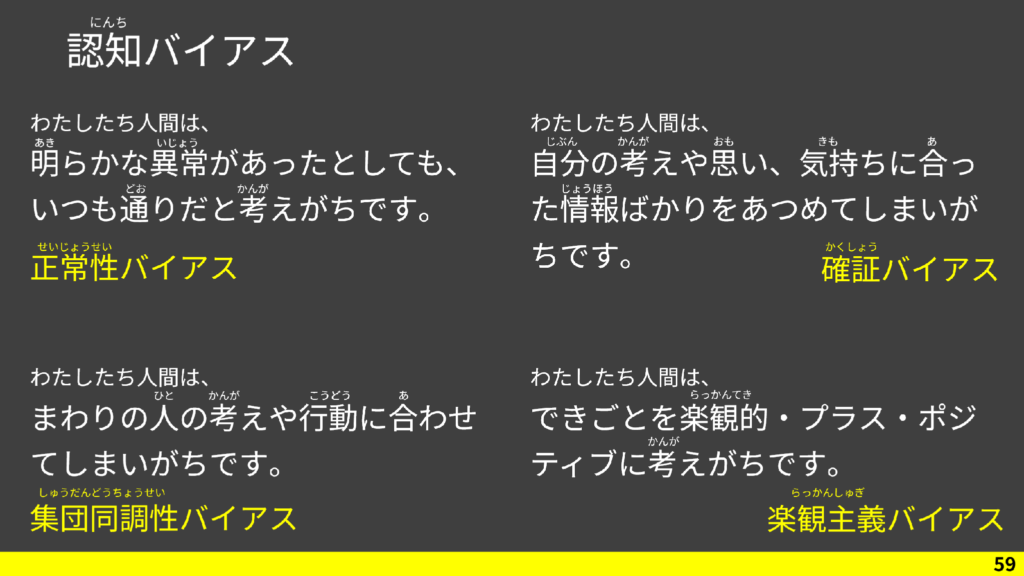
This project originates from the “co-creative disaster prevention classes” that the principal investigator has conducted for several years. These classes aim to improve disaster prevention and mitigation literacy among a wide range of participants, from elementary school students to members of the public. Here, literacy refers not only to acquiring knowledge and skills related to disasters, but also to understanding the cognitive biases that affect judgment and behavior during disasters and being able to consciously regulate one’s own attitudes and actions.
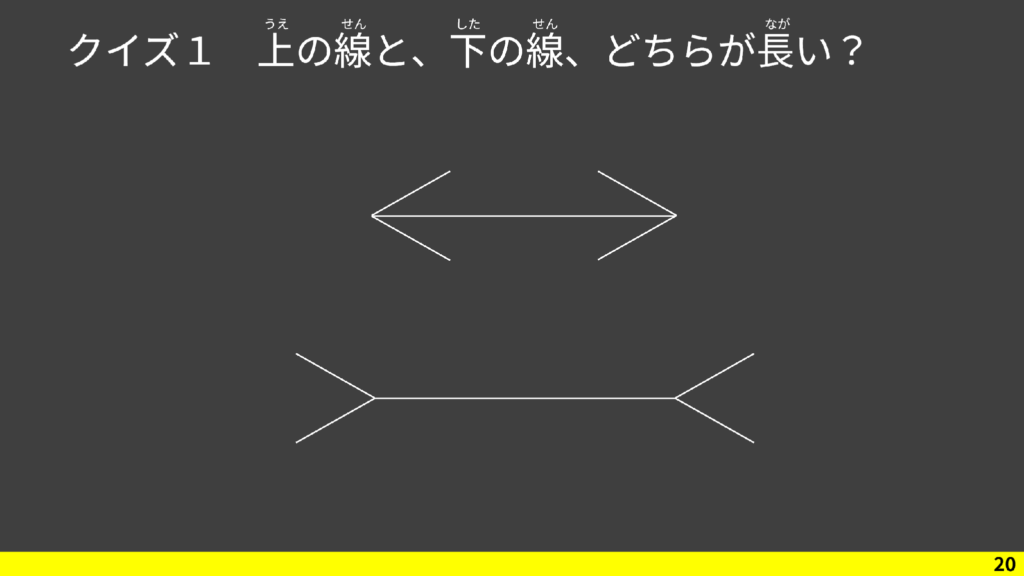
In the classes, quizzes using visual illusions and ambiguous figures challenge the naïve realist belief that “the world exists exactly as I see it,” allowing participants to experience firsthand that the same object can be seen and interpreted differently by different people. We then introduce cases in which biases such as group conformity bias influenced evacuation decisions, and conduct dialogic activities in which participants discuss with one another how they see things and why they make the judgments they do.
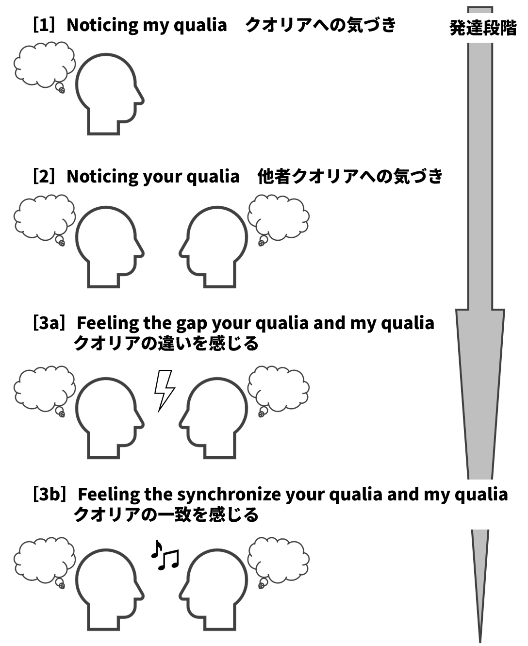
Through these classes, and by watching children express surprise at how differently others see things and talk about those differences, the principal investigator came to focus on a more fundamental issue: the importance of the ability to recognize that one’s own perceptions and ways of thinking are not the world itself but one form of subjective experience, and to understand that others may have different subjective experiences. In philosophy and consciousness research, the quality of the subjective experience that an individual directly undergoes has been called “qualia.” Rather than seeking to explain qualia themselves, this study focuses on the tendency or ability to be aware that oneself and others each have their own subjective experiences, that the content of these experiences may differ between individuals, and to relativize and reconsider one’s own perceptions. We define this as “qualia awareness.”
This study has two central questions. First, to what extent can people recognize the existence of, and differences between, their own and others’ subjective experiences? Second, how does such recognition affect dialogue, learning, self-regulation, and the modification of behavior? To answer these questions, we are pursuing (1) the development of a qualia awareness scale and examination of its relationships with related concepts such as metacognition, perspective taking, and intellectual humility; (2) examination of individual differences in the perception of visual illusions and ambiguous figures and in verbal explanations of them; (3) analysis of dialogue processes concerning different ways of seeing; and (4) the design and evaluation of educational interventions that foster qualia awareness.
These findings will be fed back into the co-creative disaster prevention classes and further developed into the design of educational practices that address a broad range of social issues, including understanding others, resolving conflicts, information literacy, and intercultural understanding.
2. Significance of the Research and Future Prospects
Not treating one’s own perceptions and ways of thinking as absolute may promote dialogue with others, enhance cognitive flexibility and intellectual humility, and lead to revised judgments in uncertain situations, including disasters. In this project, we will design and evaluate educational interventions that foster qualia awareness and feed the findings back into the co-creative disaster prevention classes. In particular, we will empirically clarify how awareness of differences in subjective experience relates to understanding cognitive biases, dialogue with others, evacuation decisions, and behavioral adjustment. Building on these findings, we will further develop the design of educational practices that contribute to solving a wide range of social and personal challenges beyond disaster prevention and mitigation, including understanding others, resolving conflicts, information literacy, and intercultural understanding.
3. Conclusion
The principal investigator has conducted “co-creative disaster prevention classes” that apply findings from cognitive science and psychology. Using visual illusions and ambiguous figures, these classes let participants experience firsthand that the same object can be seen and interpreted differently by different people. Inspired by this practice, the project defines “qualia awareness” as the tendency or ability to be aware that oneself and others each have their own subjective experiences, that their content may differ between individuals, and to relativize one’s own perceptions and ways of thinking. Through scale development, examination of individual differences in perception, analysis of dialogue processes, and the design and evaluation of educational interventions, the project will empirically clarify the psychological and social functions of qualia awareness and apply the findings to educational practices, beginning with disaster prevention education.