
Elucidating Word Recognition Mechanisms in Japanese–English Bilinguals Based on Script Differences: An fMRI Examination of Differentiation in the Visual Word Form Area
2026.09.25
Fiscal Year
FY 2025
April 2025 – March 2026
Principal Investigator
Mariko Nakayama
Graduate School of International Cultural Studies
Co-Investigators
Takumi Uchihara
Graduate School of International Cultural Studies
Hyeonjeong Jeong
Professor, Graduate School of International Cultural Studies
Tatsuya Komuro
Graduate School of International Cultural Studies
Masahiro Yoshihara
Graduate School of International Cultural Studies
Ryo Maie
Graduate School of International Cultural Studies
Yongsong Huang
Assistant Professor, Advanced Institute of So-Go-Chi (Convergence Knowledge) Informatics
Research Keywords
Visual Word Form Area (VWFA) ; Japanese–English bilinguals ; Writing systems ; fMRI
1. Research Overview
Brain research has shown that there is a specialized brain region for recognizing written characters. Known as the Visual Word Form Area (VWFA) and located in the left fusiform gyrus, its neuronal populations respond specifically to letter-like stimuli. Recent bilingual research has shown that in bilinguals whose two languages have similar scripts, such as French and English, the same VWFA region is activated, whereas in bilinguals who read and write languages with very different scripts, such as Chinese and English, different subregions of the VWFA are activated (Zhan et al., 2023). This suggests that when languages differ in their script characteristics, separate script-processing systems tailored to each language may develop in the brain.
This study aims to test, in Japanese–English bilinguals, the possibility that separate neuronal populations tailored to script characteristics develop within the VWFA, through both cross-language and within-language comparisons. (1) In the cross-language comparison, we examine whether different neuronal populations are activated when Japanese–English bilinguals read English and Japanese words, testing the reproducibility of findings from an exploratory study of Chinese–English bilinguals with a limited sample (Zhan et al., 2023; N = 10). (2) In the within-language comparison, we examine whether different neuronal populations are activated when native speakers of Japanese read words written in katakana and kanji. If separate neuronal populations develop according to script characteristics, similar results should also be observed for reading katakana and kanji.
Participants were 41 adult native speakers of Japanese with TOEFL ITP scores of 520 or higher. In an object detection task, stimuli were presented continuously on a computer monitor, and participants were asked to detect targets (such as ★ or #### marks) that appeared at irregular intervals and to press a button quickly and accurately. A localizer task was first used to identify, for each participant, the VWFA subregions involved in processing English, kanji, and katakana; the main trials then tested whether these subregions responded selectively to each script. For each script, stimuli were graded from meaningless combinations of lines to forms progressively closer to real words.
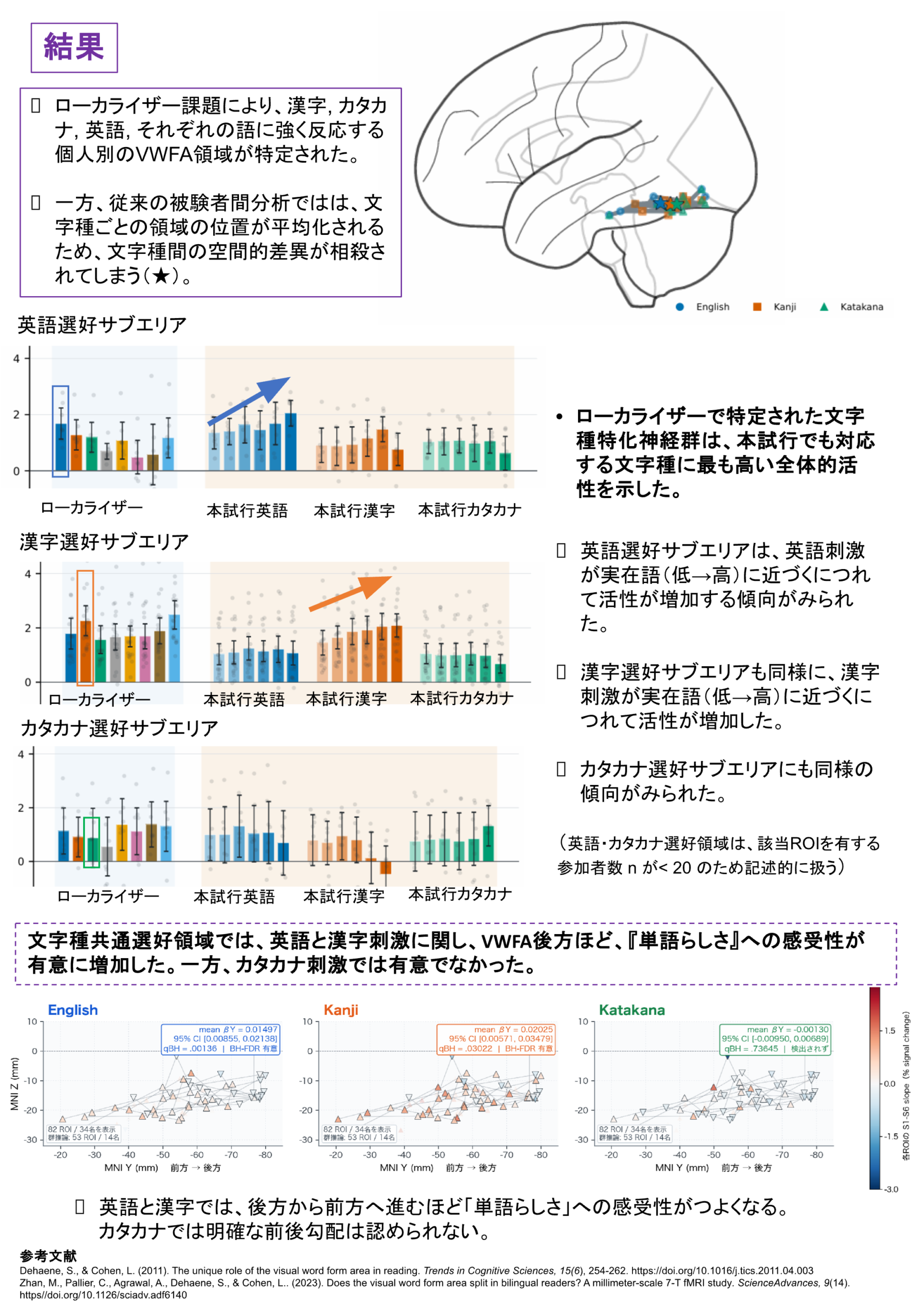
The localizer task identified individual VWFA regions that responded strongly to kanji, katakana, and English words, respectively. In contrast, conventional between-participant analyses average the locations of these regions across participants, canceling out spatial differences between scripts. The script-specific neuronal populations identified by the localizer also showed the highest overall activity for the corresponding script in the main trials. In the English- and kanji-preferring subregions, activity tended to increase as stimuli became closer to real words, and a similar tendency was observed in the katakana-preferring subregion (the English- and katakana-preferring regions were treated descriptively because fewer than 20 participants had these regions). In addition, in regions responsive to all scripts, a significant gradient in sensitivity to “word-likeness” was observed along the posterior–anterior axis of the VWFA for English and kanji stimuli, whereas no clear gradient was found for katakana stimuli.
2. Significance of the Research and Future Prospects
The results suggest, in Japanese–English bilinguals, that separate neuronal populations within the VWFA may be involved in reading languages and scripts with very different characteristics. A distinctive feature of this study is that it examines not only differences between languages (English and Japanese) but also between scripts within the same language (kanji and katakana), and that, by identifying subregions for each individual, it captures spatial differences between scripts that are canceled out in conventional between-participant analyses. These findings contribute to understanding the relationship between the neural basis of reading and writing systems. Because the number of participants with English- and katakana-preferring regions was limited, further investigation is expected in future work.
3. Conclusion
This study conducted an fMRI experiment with 41 Japanese–English bilinguals to test whether different neuronal populations are involved in reading English, kanji, and katakana within the Visual Word Form Area (VWFA) in the left fusiform gyrus, a region involved in recognizing written characters. Individual localizer tasks identified VWFA subregions that responded strongly to each script, and these subregions also showed the highest activity for the corresponding script in the main trials. These results support the possibility that separate script-processing systems tailored to script characteristics develop in the brain.