Paper Accepted at the International Conference on Knowledge and Systems Engineering (KSE 2026)
2026.11.04
The AI So-Go-Chi Center is pleased to announce that the following paper, co-authored by Associate Professor Teeradaj Racharak and Assistant Professor Watanee Jearanaiwongkul, has been accepted for presentation at the 18th International Conference on Knowledge and Systems Engineering (KSE 2026). The conference will be held in Kanazawa, Japan, from November 11 to 14, 2026. KSE is an international forum for presenting and discussing the latest research, development, and applications in knowledge engineering and systems engineering.
Accepted Paper
Teeradaj Racharak, Mulati Renati, Watanee Jearanaiwongkul, Shinobu Hasegawa,
Explainable AI for Video Classification: Extending Intrinsically Interpretable Image Models to Facial Expression Recognition
In Proceedings of the 18th International Conference on Knowledge and Systems Engineering (KSE 2026), Kanazawa, Japan, November 11–14, 2026.
Video-based classification is increasingly used in affective computing and other human-centric applications, where a model must be not only accurate but also transparent about why a decision is made. Most existing video explanation methods apply post-hoc saliency techniques to each frame independently, which can produce explanations that are unstable over time.
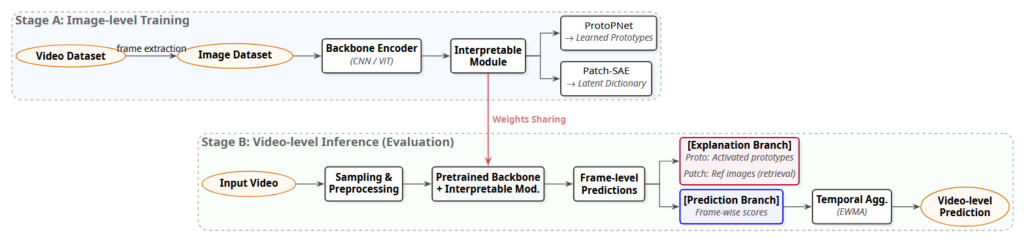
This paper presents a unified framework that separates video understanding into an inherently interpretable image-level reasoner, which makes and explains predictions frame by frame, and a lightweight temporal aggregation step based on an Exponentially Weighted Moving Average (EWMA), which stabilizes predictions without black-box temporal parameters. Within this framework, the authors compare two interpretable approaches: prototype-based ProtoPNet and dictionary-based PatchSAE. Experiments on the RAVDESS facial expression dataset, together with the DIEM-A and WLASL-10 benchmarks, show that interpretable image models transfer effectively to video: ProtoPNet gives stable, part-based facial explanations, while PatchSAE adapts better to body and hand motion.
The framework offers a transparent alternative to black-box video models and a baseline for explainable video understanding.
Congratulations to the authors on this achievement!