Paper Accepted at the Pacific Rim International Conference on Artificial Intelligence (PRICAI 2026)
2026.11.04
The AI So-Go-Chi Center is pleased to announce that the following paper, co-authored by Associate Professor Teeradaj Racharak, has been accepted for presentation at the 23rd Pacific Rim International Conference on Artificial Intelligence (PRICAI 2026). The conference will be held in Guangzhou, China, from November 16 to 20, 2026. Held across the Pacific Rim since 1990, PRICAI is a long-standing international conference that brings together researchers, practitioners, and educators to present advances in all areas of artificial intelligence.
Accepted Paper
Ziheng Zhong, Teeradaj Racharak,
Klotski-Bench: A Diagnostic Benchmark for Structured Spatial State-Transition Reasoning in Large Language Models
In Proceedings of the 23rd Pacific Rim International Conference on Artificial Intelligence (PRICAI 2026), Guangzhou, China, November 16–20, 2026.
Code: https://github.com/realearn-people/Klotski-Bench
Evaluating large language models (LLMs) on structured reasoning requires more than checking final answers. In problems where a situation changes step by step, a model must keep each intermediate state valid, apply only legal actions, and stay consistent across a series of dependent updates.
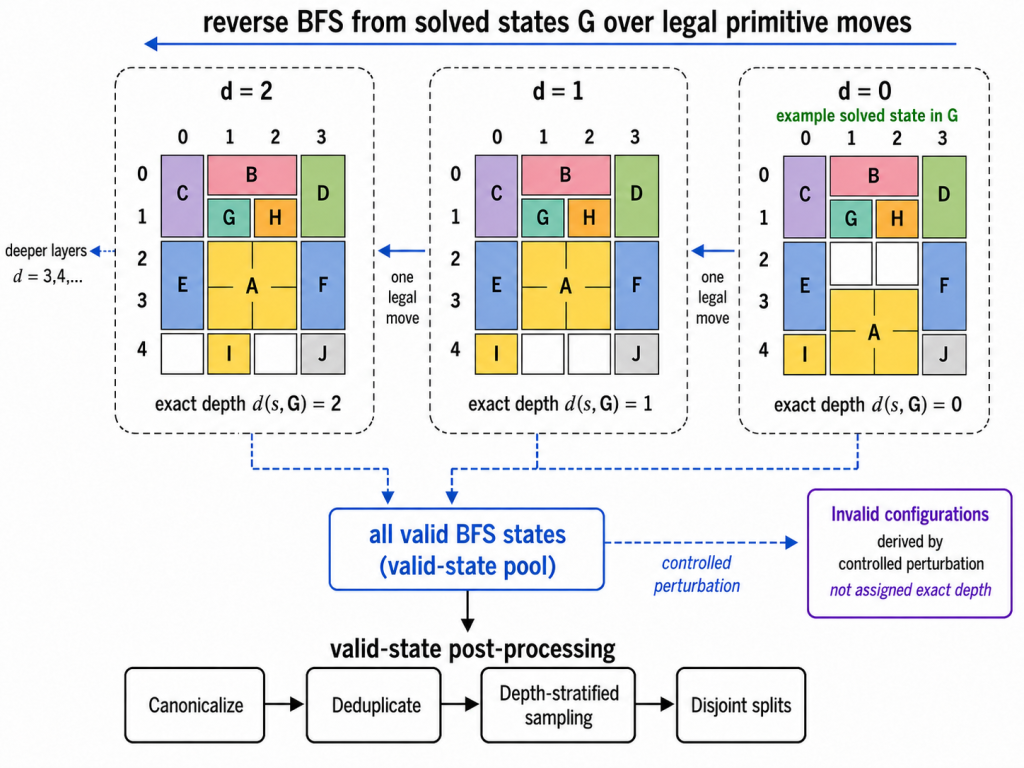
This paper introduces Klotski-Bench, a diagnostic benchmark based on the Klotski sliding-block puzzle. The puzzle is formalized as a deterministic transition system with explicit board states, block movements, legality constraints, and simulator-checkable next states. Seven tasks cover state validity judgment, state error localization, legal action enumeration, next-state prediction, one-step transition verification, trajectory generation, and trajectory verification. Valid instances are generated by reverse breadth-first search (BFS) from solved configurations, which assigns each state an exact shortest-path depth and enables evaluation at controlled difficulty levels.
Klotski-Bench provides a controlled, fully verifiable testbed for analyzing whether language models can track spatial states and correctly apply local transition rules over multi-step trajectories.
Congratulations to the authors on this achievement!